
Why Delaware County Records Split
Delaware County criminal records live in four main systems because each office records a different event. A village police department or the Sheriff writes the incident and arrest report. The county correctional facility records intake and custody. A town or village Justice Court, or later County Court, creates the docket. Fingerprints from a reportable arrest can also open or update a New York State Identification record at the Division of Criminal Justice Services, known as DCJS. The same case can look different in each system until the agencies report all later steps.
The Delaware County government directory shows the local departments that make up this chain.
The directory is a useful official starting point when the record holder is not yet clear. For a village event, the police agency still owns its report after a person is booked by the county. For a felony disposition, the court clerk is the better source. DCJS holds an identity-matched history, but it is not an ordinary public name-search product.
Delaware County Criminal History Checks
Start with the question the record must answer. A pending appearance calls for WebCriminal and the named court. A final felony result calls for the County Clerk. Current county custody routes through the Sheriff-linked VINE service. A person who needs their own statewide fingerprint record uses DCJS Personal Record Review. An OCA Criminal History Record Search, or CHRS, is a separate name and date-of-birth court search. It costs $95 per name and omits sealed matters.
The Delaware County Clerk page confirms the court-record counter and its office hours.
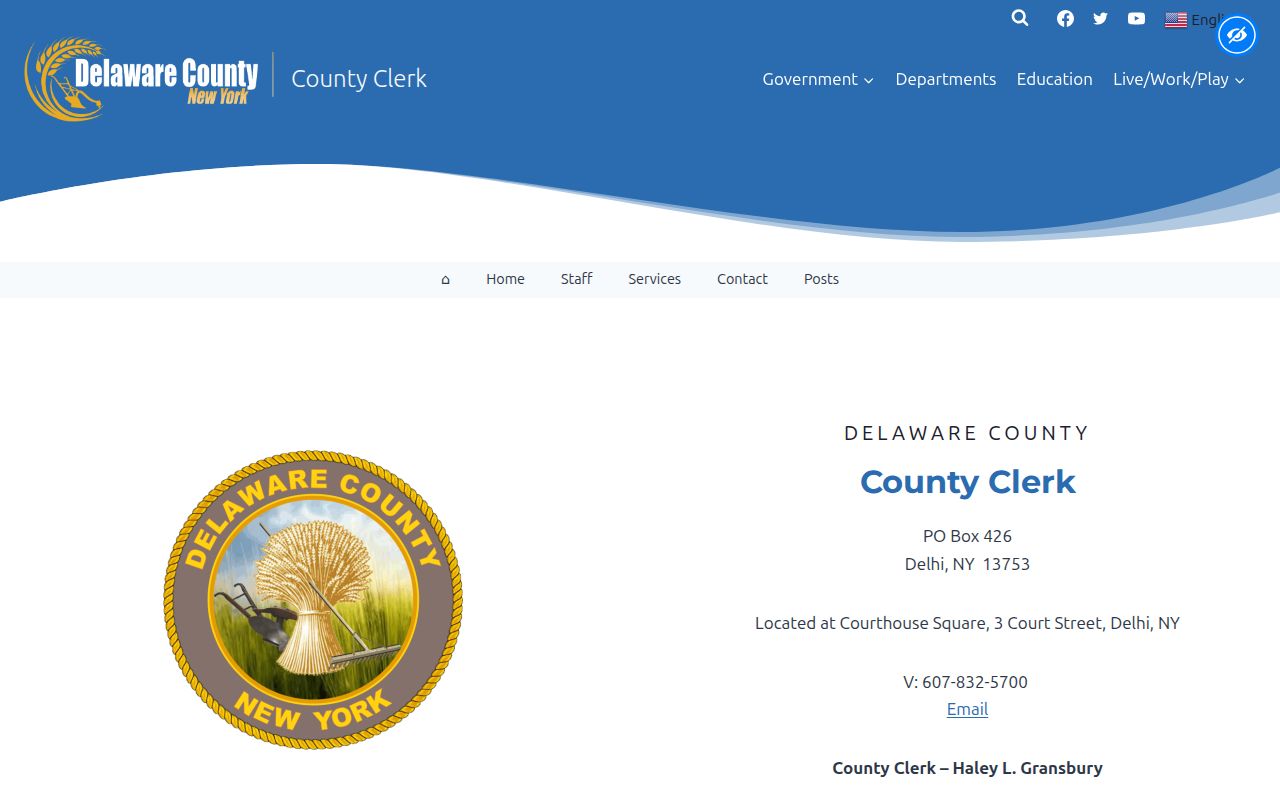
The clerk at 3 Court Street in Delhi maintains Supreme and County Court criminal files. Use this order to avoid sending one request to the wrong office:
- Identify whether the target is an arrest report, custody entry, court case, warrant, registry listing, or personal rap sheet.
- Search WebCriminal for a pending covered case, using a defendant name, full case number, or known court date.
- Call the exact local Justice Court when a lower-level or finished matter does not appear online.
- Ask the County Clerk for a felony file or certificate of disposition, with the filing year and docket number if known.
- Use fingerprints through IdentoGO when reviewing your own official DCJS record.
Delaware County's 23 Court Search
Delaware County has 20 towns, eight villages, and 23 local Justice Courts. That spread matters in a rural county covering 1,442.44 square miles. A misdemeanor, traffic matter, violation, or first felony arraignment may begin at a local clerk's counter far from Delhi. If a felony is later indicted, the case moves to County Court and receives a superior-court file. A search that checks only the County Clerk can therefore miss an earlier local docket. A WebCriminal miss can also mean that a matter is finished, outside the portal's coverage, or sealed.
The key is to read the appearance ticket, release paper, or docket notice for the issuing court. The District Attorney appears in County Court and all 23 local courts, but that office says it has no public database of case or ticket numbers. Ask the court clerk, not the prosecutor, to locate a public file. When only an approximate year is known, provide the full name, likely court, and narrow date range. Older records may require a staff search.
Official Background Checks in New York
New York has no public DCJS name search. A person may review their own fingerprint-linked New York record, or authorize delivery to their attorney, through IdentoGO. Service code 15464Z requests the suppressed version, which reflects the ordinary unsealed view. Code 15465F requests the unsuppressed version, which lets the subject see sealed or suppressed entries. DCJS lists $47.50 for in-state fingerprint processing as of February 2, 2026. The mailed response usually takes three to four weeks, and DCJS provides a fee-waiver route.
The DCJS Record Review instructions explain the fingerprint process and current service codes.
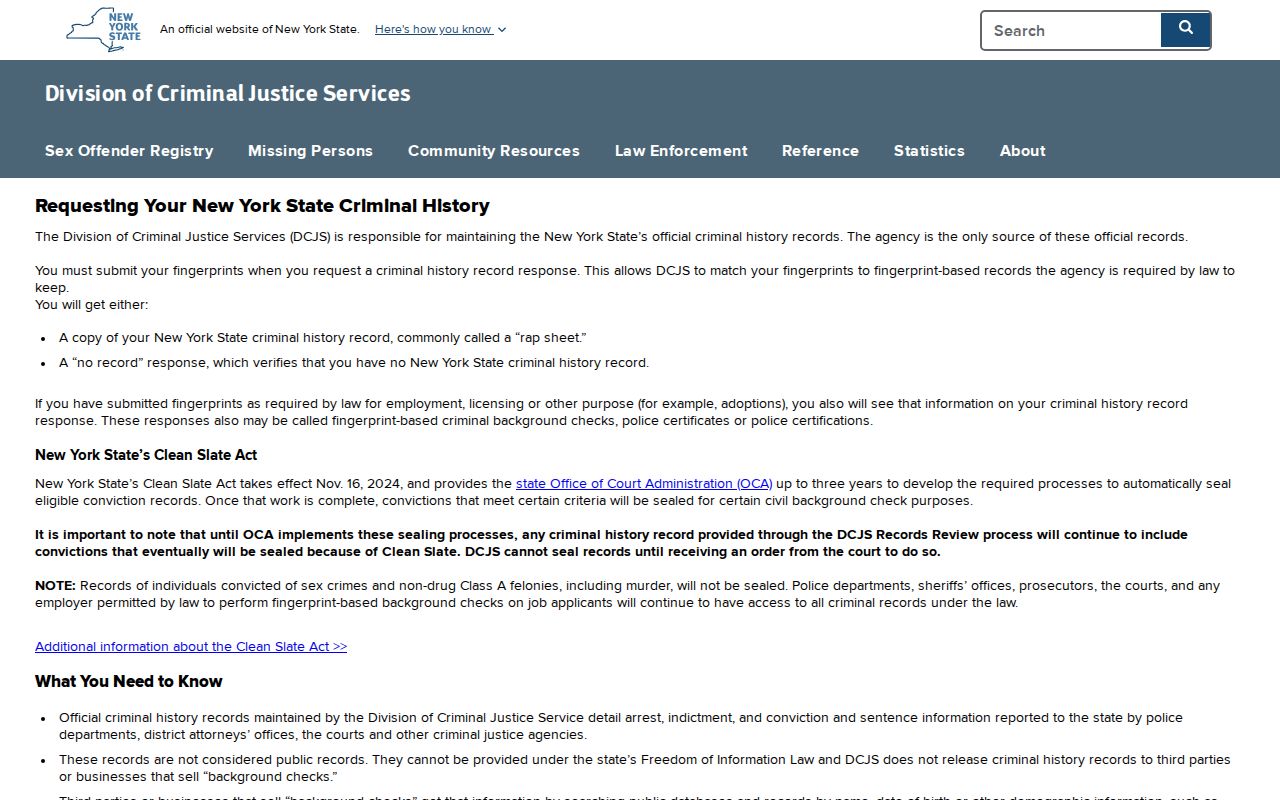
This is the identity-matched state rap sheet route, not a public lookup of someone else. The Office of Court Administration offers CHRS for public statewide court-history searching by exact name and date of birth. CHRS is not fingerprint verified, so spelling variants and common names can affect results.
The OCA CHRS order page describes that distinct court-record product.
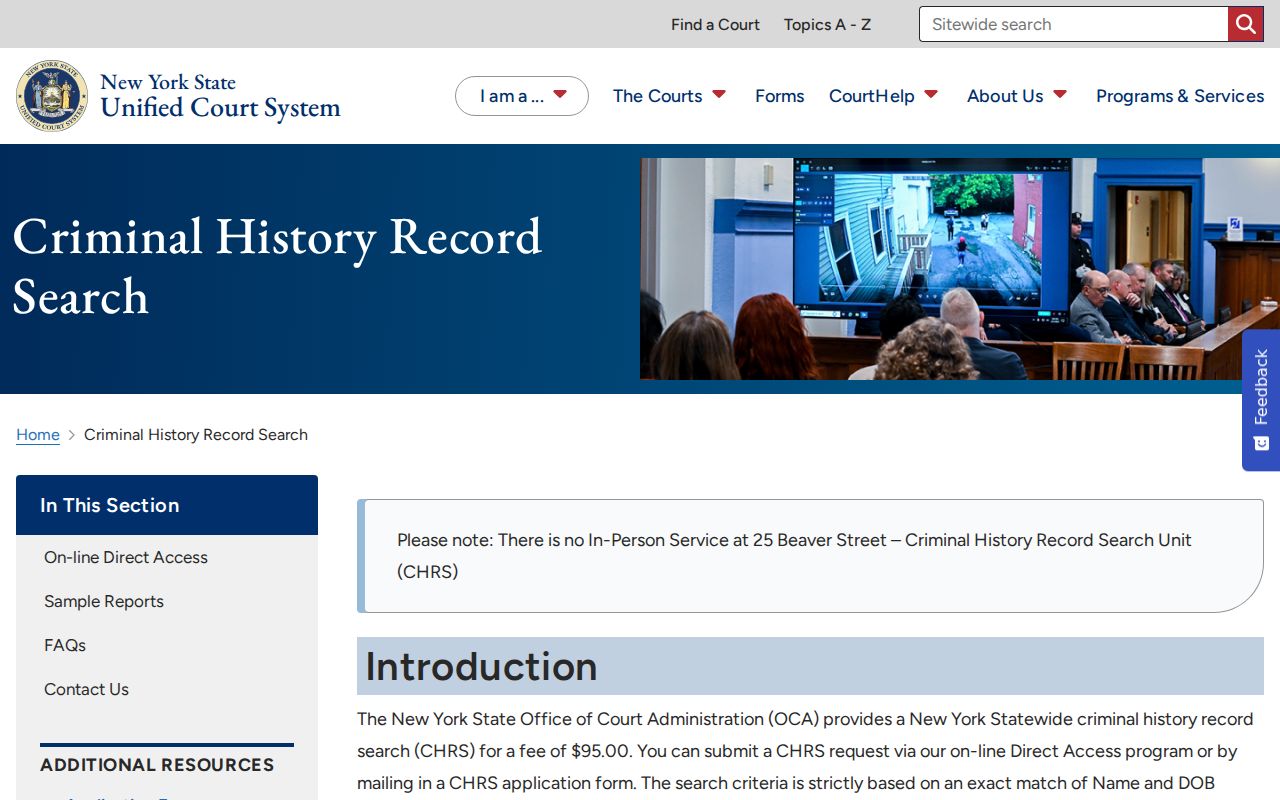
For a national review of your own fingerprint submissions, the FBI Identity History Summary is another separate channel. None of these products replaces a certified disposition from the court that decided a case.
| Channel | Scope | Published cost |
|---|---|---|
| DCJS IdentoGO review | Your own New York rap sheet | $47.50 as of 2/2/2026 |
| IdentoGO Cardscan | Mailed fingerprint processing | $17.50 as of 2/2/2026 |
| OCA CHRS | Public New York court history by name and DOB | $95 per name |
| County Clerk | Local case copies and certificates | Fee not located in official sources |
Get Your Delaware County DCJS Record
Choose the DCJS version with care. A suppressed review is useful for seeing the record available through ordinary unsealed criminal-history dissemination. An unsuppressed review adds material hidden from that view, including favorable-termination seals, certain violation matters, eligible sealed convictions, and youthful-offender entries. The broader copy helps a person find a missing outcome before filing a correction or a sealing request. It does not make those entries public.
Enroll with the correct service code, bring an accepted identity document, and pay the current IdentoGO charge. If a live fingerprint site is not practical, DCJS permits Cardscan after enrollment using an FD-258 card. DCJS publishes two Record Review phone lines, 518-457-9847 and 518-485-7675, and accepts questions at RecordReview@dcjs.ny.gov. If an arrest cycle lacks its outcome, obtain the certified court disposition and submit a challenge. The court fixes the source document; DCJS then matches the reported result to the fingerprint cycle.
Note: A DCJS personal review is not the same record as an OCA name-based CHRS result.
Kinds of Criminal Records
The phrase criminal record can refer to several documents, and no one Delaware County office holds them all. Police narratives can include witness and evidence details that are later redacted. Booking records focus on intake and custody. Court files show what was formally charged and how the judge resolved it. A DCJS rap sheet links reportable cycles by fingerprint. Warrants and supervision files have their own limits. Using the correct name for the document makes a records request much easier to process.
- Incident or arrest report: held by the Sheriff, village police, or State Police unit that handled the event.
- Booking record: created at the Delaware County correctional facility and requested from the Sheriff.
- Court case file: kept by the local Justice Court or the County Clerk, based on the case level.
- DCJS rap sheet: a fingerprint-linked state record available to the subject through Personal Record Review.
- Registry record: a controlled DCJS public disclosure for qualifying Level 2 and Level 3 registrations.
The New York Sex Offender Registry Subdirectory is the official Level 2 and Level 3 public search.
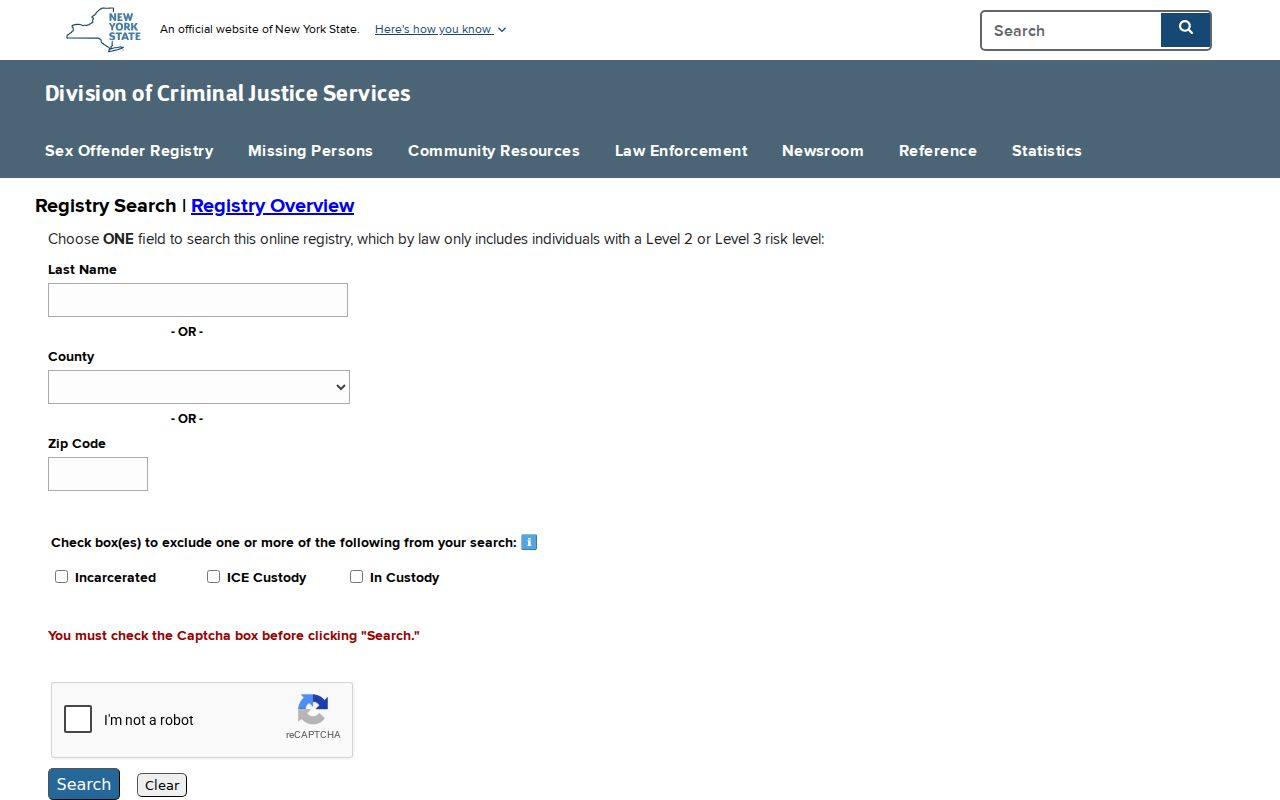
The registry is a distinct statutory system, not a general criminal-history search. Level 1 information is not browsable in the public online Subdirectory.
Delaware County Custody Is Not History
The Delaware County Sheriff links readers to VINE for current custody and notification. VINE can help locate a person who may be held at the county facility, but a miss is not proof that no arrest occurred. Release, transfer, a spelling mismatch, or an arrest that did not lead to county booking can all produce no result. The Sheriff does not publish a county-built historical booking roster or mugshot gallery. Call 607-832-5555 when custody must be confirmed.
The Sheriff-linked VINE route is the official county custody entry point.
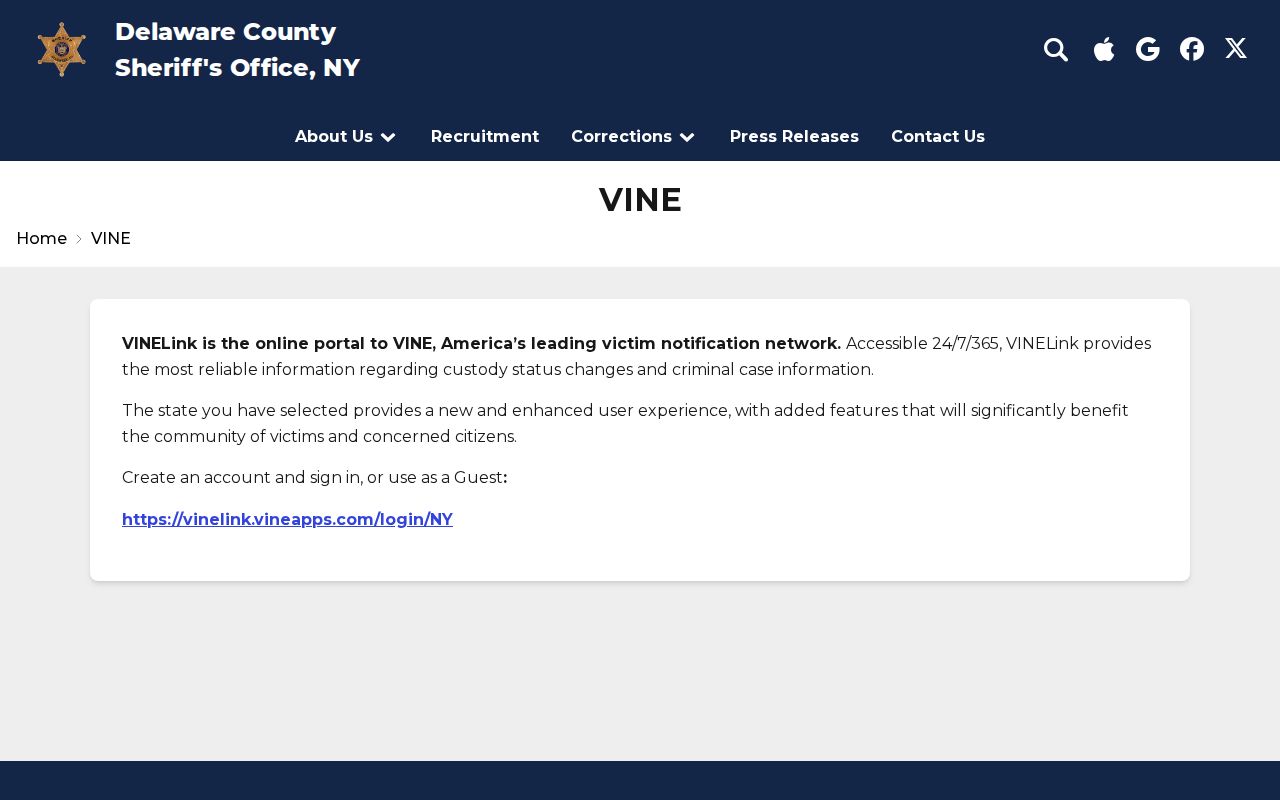
VINE describes current custody, not a lifetime arrest record. A sentenced person transferred to state prison belongs in the DOCCS system.
The DOCCS Incarcerated Individual Lookup searches state custody by DIN, NYSID, or name criteria.
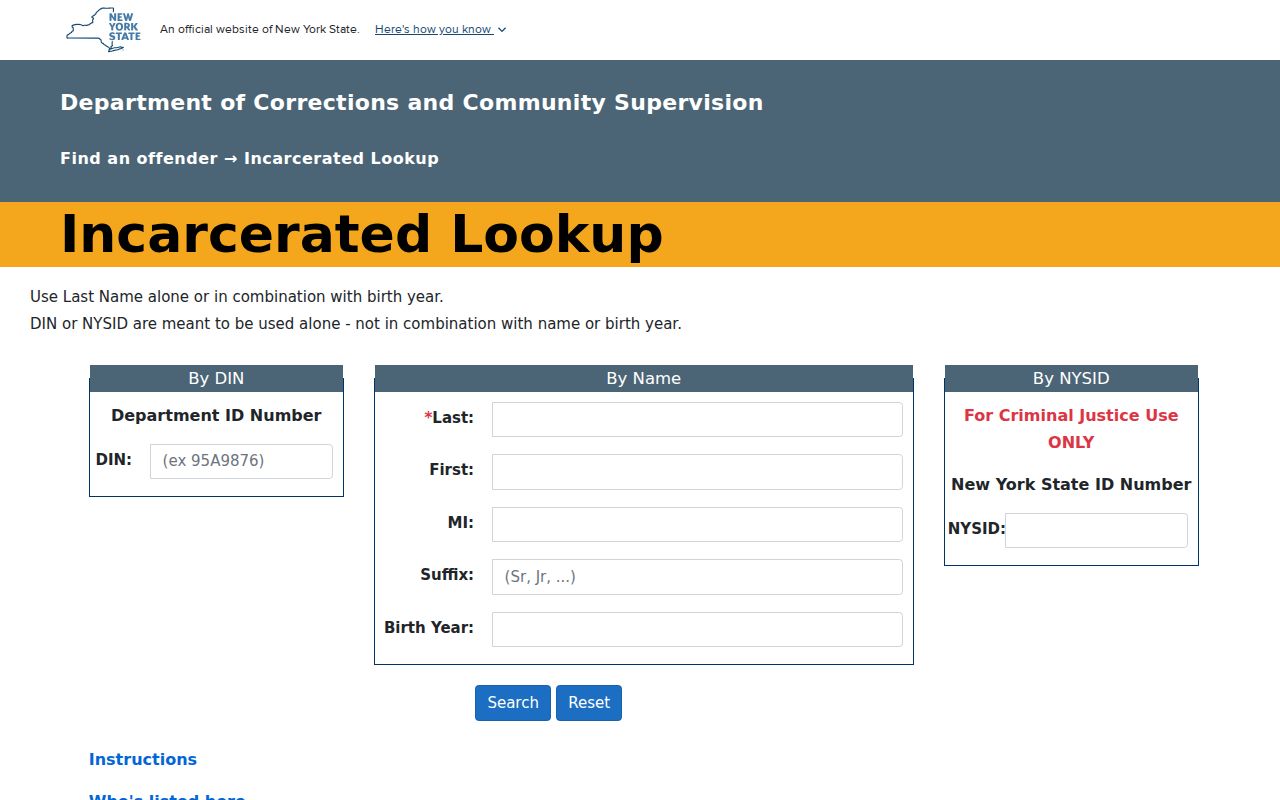
DOCCS results can show facility, custody status, admission and release data, and sentence dates, subject to exclusions. Federal custody instead routes to the Bureau of Prisons locator.
Delaware County Criminal Records: What They Contain
Read each field in light of the office that supplied it. An arrest charge reflects the officer's allegation at the time of arrest. A filed count comes from the accusatory instrument or indictment. A disposition states what the court finally did. Those items can differ without any error. Names, aliases, birth data, NYSID, docket numbers, and agency numbers help connect the documents, but public versions omit confidential identifiers and sealed information.
| Name and identifiers | Legal name, aliases, date of birth, docket number, agency number, NYSID, or DIN when that system uses it. |
|---|---|
| Arrest and booking | Event date, arresting agency, alleged charge, intake time, custody status, and bond or release data when public. |
| Filed charges | Complaint, information, indictment, statute citation, and charge class accepted by the court. |
| Disposition | Pending status, dismissal, acquittal, plea, verdict, conviction, or youthful-offender outcome where disclosure is lawful. |
| Sentence | Custody, probation, fine, surcharge, conditional discharge, or other order in the judgment. |
| Supervision | Public sentence or DOCCS status, while private probation and parole case notes remain restricted. |
- Disposition
- The legal outcome of a charge or case.
- Certificate of disposition
- A clerk-certified summary of the final case result.
- Arrest cycle
- A DCJS grouping that connects an arrest to later reported court and sentence events.
- NYSID
- The New York identification number tied to fingerprint-based state history.
Three Delaware County Charge Facts
An arrest charge, a filed charge, and a final disposition answer three different questions. Police state why custody or an appearance ticket began. The prosecutor and court state what count moved forward. The judgment states the outcome. A felony complaint may start in Sidney, Walton, Delhi, or another local court, then become an indictment or superior court information in Delaware County Court. The later file can carry a new docket number and different legal counts.
That change is why an arrest search should not end with a police release or booking line. Follow the case to its arraigning clerk, then to County Court if grand-jury action or an indictment moved it. For a fuller explanation of filed counts, motions, pleas, and judgment entries, use the Delaware County court case lookup. If a dismissed matter still appears on your own rap sheet, order an unsuppressed DCJS review, secure the certified court outcome, and use the DCJS challenge process.
New York Public Access Laws
New York law separates agency records, court records, and DCJS criminal-history data. FOIL can reach existing Sheriff or police material unless an exemption protects all or part of it. Court clerks search and certify files under judiciary access rules. Executive Law gives DCJS its fingerprint and dissemination role, so a rap sheet is not obtained through a routine public FOIL request. Sealing laws can also remove cases from public court searches even though an unsuppressed personal review still shows them to the subject.
Key New York statutes:
Public Officers Law Article 6 opens existing agency records subject to exemptions and redaction.
Judiciary Law Section 255 directs court clerks to search and certify records in their custody when lawful fees are paid.
Executive Law Section 837 authorizes DCJS criminal-history and fingerprint dissemination functions.
CPL 160.50 generally seals records after a qualifying favorable termination.
CPL 160.59 permits applications to seal certain eligible convictions under stated limits.
A FOIL request should describe the existing record with an incident number, date, location, agency, and narrow date range. Within five business days, an agency must grant, deny in writing, or acknowledge the request and give an approximate reasonable response date. That is not a promise of full production within five days.
Delaware County Programs Affect Records
Probation and diversion programs can create docket events without making private supervision notes public. Delaware County Probation operates from 280 Phoebe Lane, Suite 2, beside the Sheriff complex. Its published work includes countywide pretrial release, electronic monitoring, community service, Behavioral Health Clinic links, and ignition-interlock oversight. A public court file may show a release order, probation sentence, violation filing, or resentencing. It will not provide the department's private case-management notes.
The Delaware County Probation page describes these local programs. The District Attorney also offers an online Traffic Diversion Program for qualifying minor traffic matters and limited prior history. Its 30-day completion period starts when the person applies, not when the application is approved. The DA warns that its office has no database of ticket or case numbers, so the issuing court remains the source for that identifier and the final docket.
Restricted, Sealed & Expunged Records
New York primarily uses sealing rather than broad expungement for ordinary criminal convictions. A qualifying dismissal or acquittal generally seals under CPL 160.50. CPL 160.59 permits a person with no more than two eligible convictions, and no more than one felony, to apply in the sentencing court after the statutory waiting period. Drug-case conditional sealing and marijuana expungement follow separate rules. Juvenile, youthful-offender, grand-jury, victim, medical, and supervision material also has special restrictions.
Clean Slate under CPL 160.57 took effect on November 16, 2024. The Office of Court Administration has through November 16, 2027 to build the automatic-sealing process. Eligible misdemeanors generally use a three-year period after completion, while eligible felonies generally use eight years, subject to the statute and pauses for new charges or convictions. Sex offenses and non-drug Class A felonies are excluded. Until a sealing order reaches DCJS, a future-eligible conviction can still appear on a personal review.
Begin with a certificate of disposition from each sentencing court and an unsuppressed DCJS record. File in the court of conviction, keep certified copies of the order, and check both the public court channel and a later personal review. A sealed record is not always destroyed, and authorized criminal justice recipients may retain access defined by law.
Delaware County Archives Since 1797
Modern portals do not cover the full span of Delaware County criminal history. Delaware County was erected in 1797, and the court archive includes Court of General Sessions criminal minutes and files from 1797 through 1895. Those files are organized by year and then in court order. They offer a route for genealogy, local history, and old case research that has nothing to do with a current WebCriminal result.
The County Clerk is the practical first contact for County and Supreme Court files, certificates of disposition, older minutes, and archived indictments. Its office is at 3 Court Street, PO Box 426, Delhi, NY 13753, and the public number is 607-832-5700. Hours are 8:30 a.m. to 4:30 p.m. on weekdays. Give staff a full name and approximate year. An old search may take time because the material is arranged as an archive rather than a modern name index.
City-by-City Criminal Records in Delaware County
Delaware County has no incorporated city, so the local profiles cover its three largest incorporated villages: Sidney, Walton, and Delhi. Each village police department keeps its own incident and arrest narratives. County booking does not transfer ownership of that report to the Sheriff. Local Justice Courts also hold eligible village matters and arraignments, while indicted felonies move to County Court in Delhi. Population ranking follows the village list in the county research; town figures are not substituted for village counts.
Sidney Record Check
Sidney Police at 21 Liberty Street holds village incident reports, while county custody routes through the Sheriff.
Walton Record Check
Walton Police creates its reports, and Walton Village Court keeps eligible local case files.
Delhi Record Check
Delhi has separate police, local court, County Clerk, and Sheriff counters within the county seat.
Delaware County Sheriff Record Requests
The Sheriff's Office is at 280 Phoebe Lane, Suite 1, Delhi, NY 13753. Its public number is 607-832-5555, and published administrative hours are 8:00 a.m. to 4:30 p.m. on weekdays. Use this office for Sheriff incident reports, county booking questions, warrants, and custody routing. It cannot release another police department's narrative merely because the person later entered county custody.
The official Delaware County Sheriff contact page confirms the office location and hours.
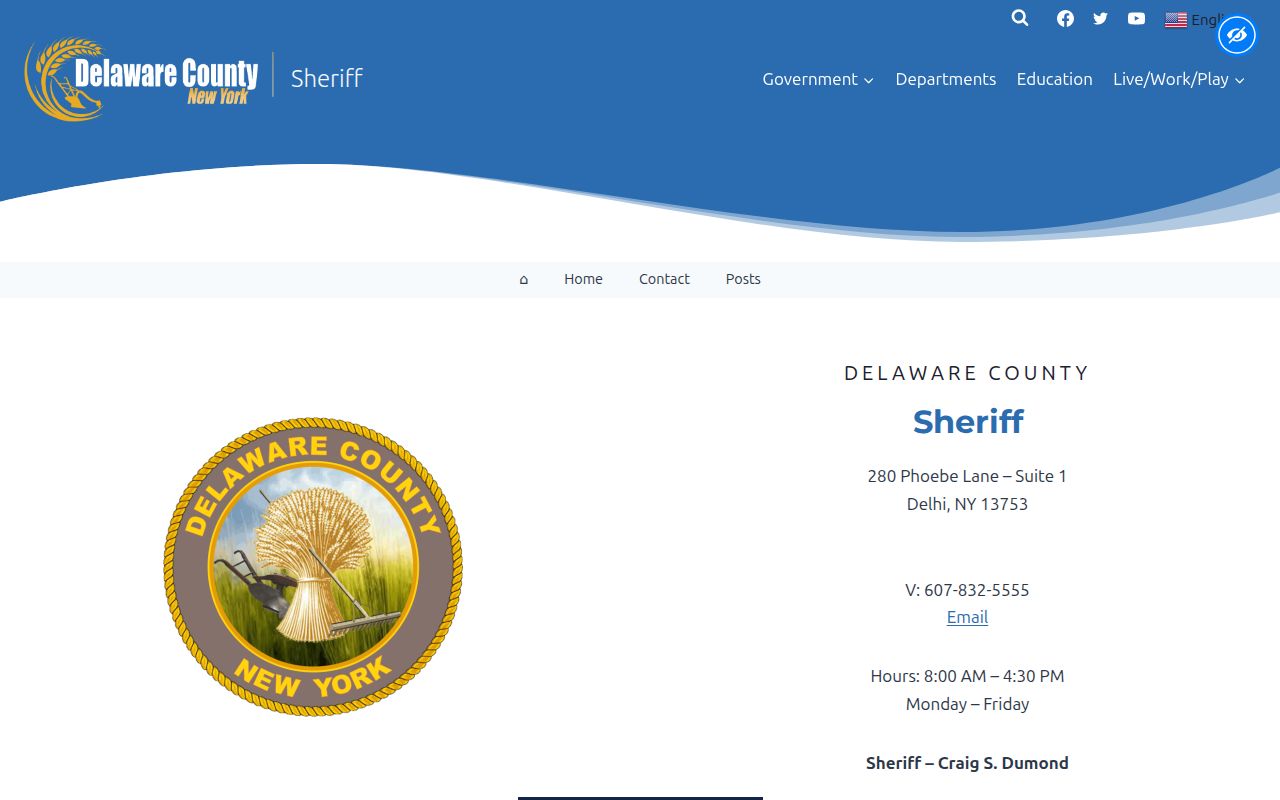
This county page is the best source for the main government contact. The separate operational site carries divisions, alerts, and the VINE route.
The Sheriff operational website provides those live agency links.
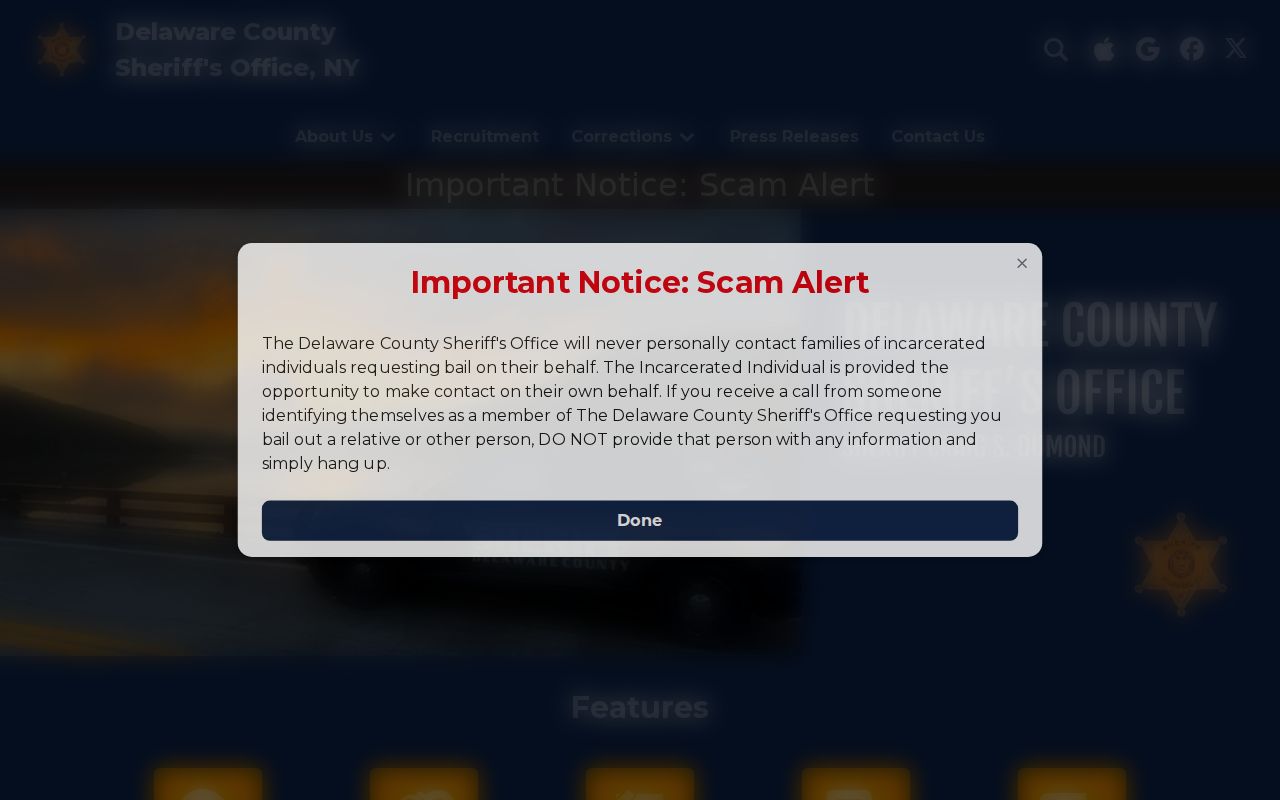
No official county name-search warrant database or full booking archive was confirmed there. For a nonpublic existing record, make a narrow FOIL request and ask for a written exemption basis if any part is withheld.
Sheriff and Correctional Facility
280 Phoebe Lane, Suite 1
Delhi, NY 13753
607-832-5555
Weekdays, 8:00 a.m. to 4:30 p.m.
County Clerk
3 Court Street, PO Box 426
Delhi, NY 13753
607-832-5700
Weekdays, 8:30 a.m. to 4:30 p.m.